In the product
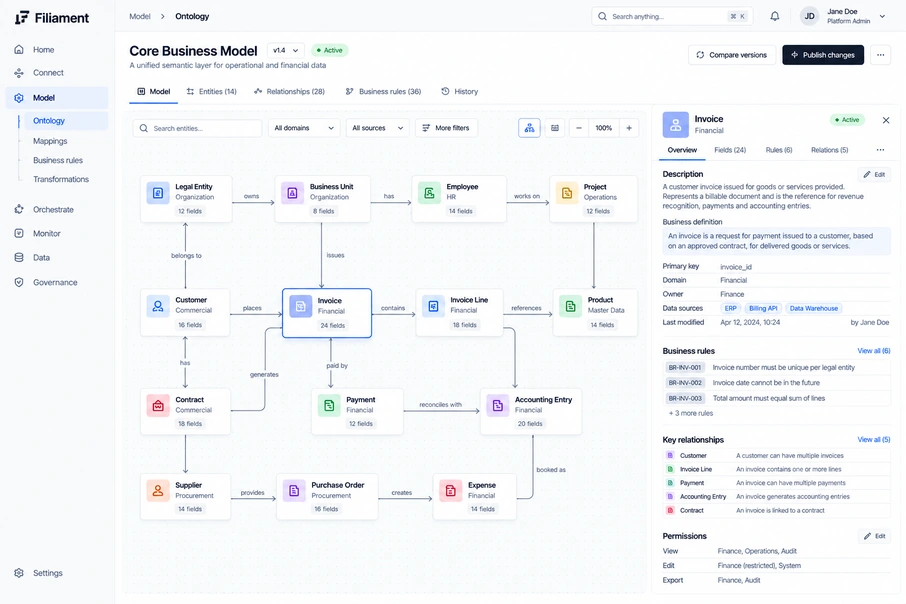
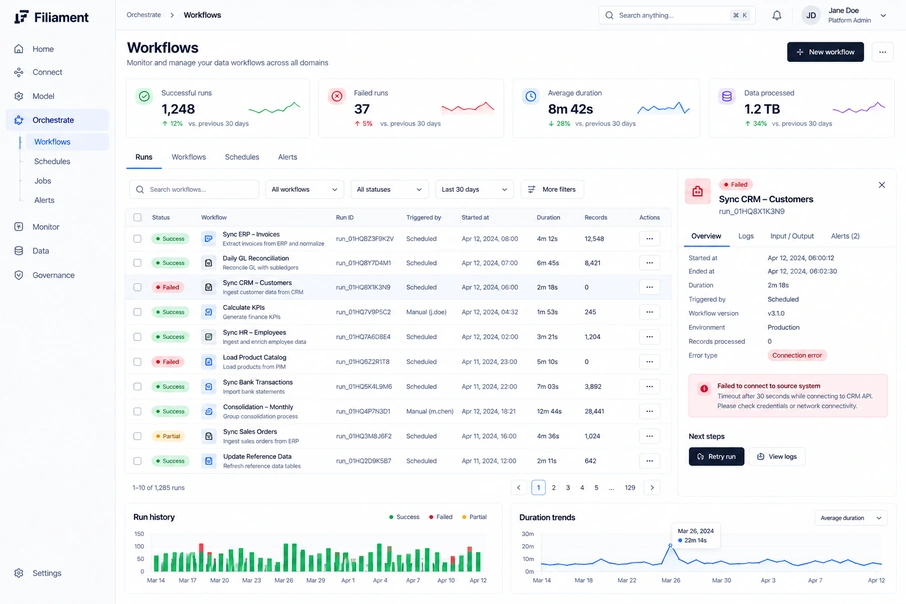
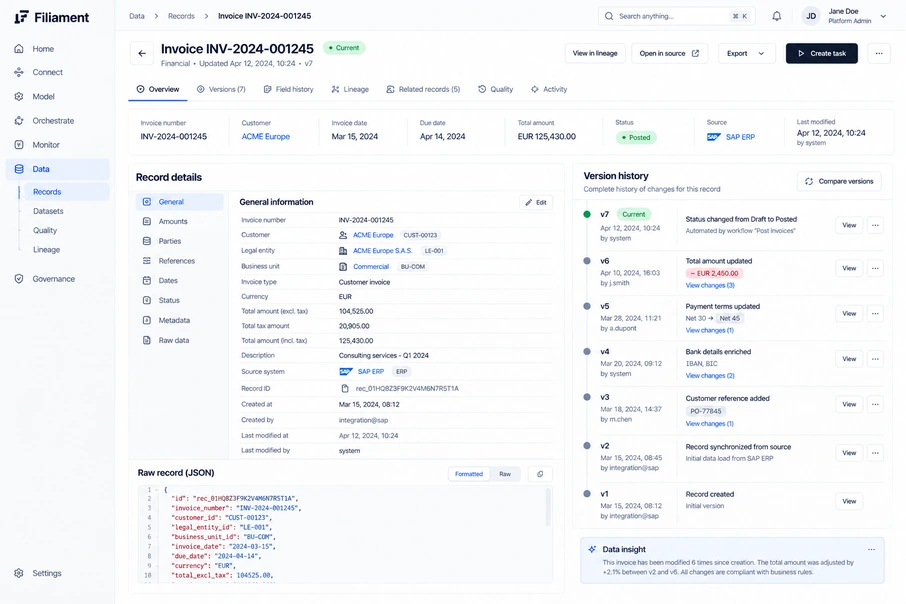
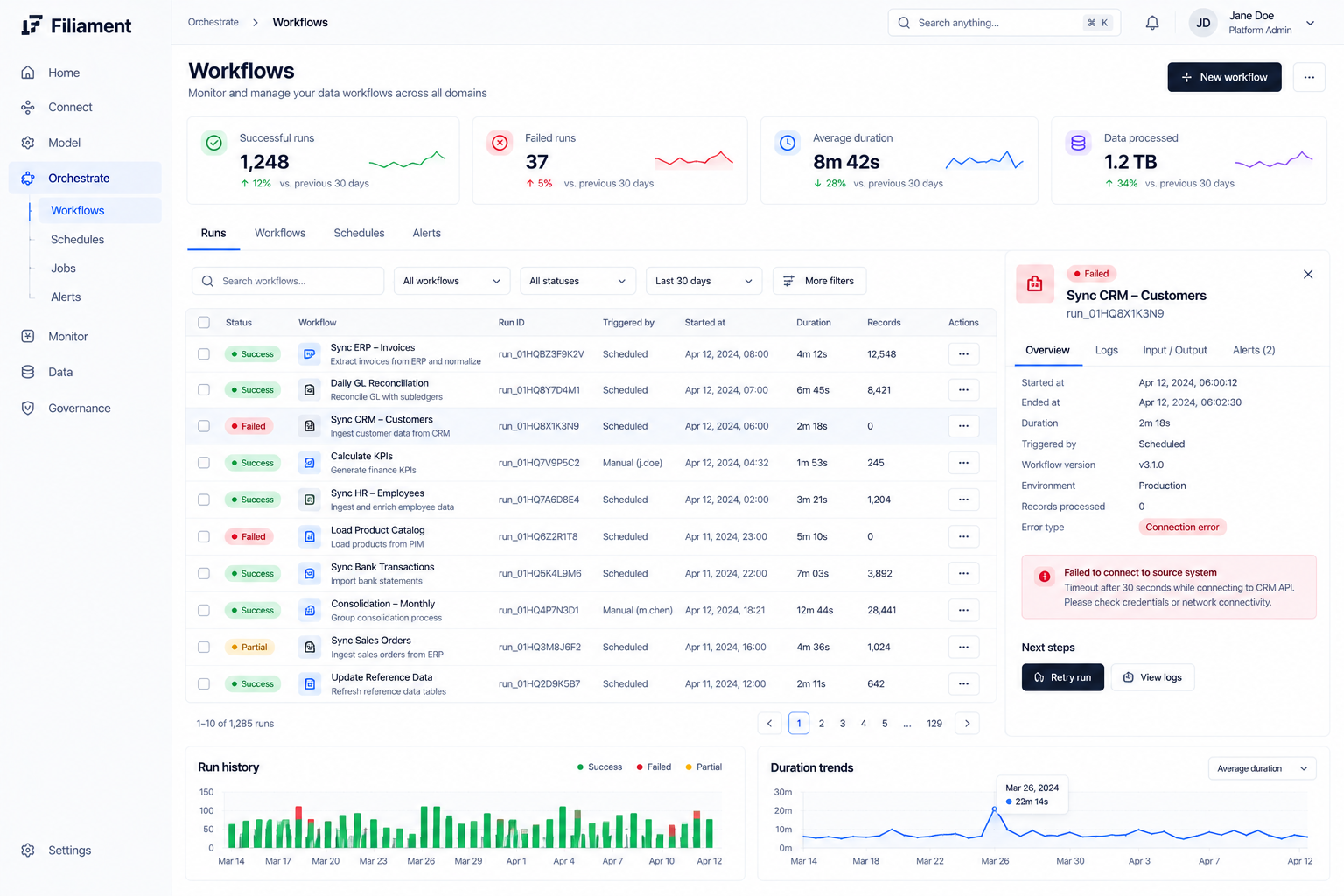
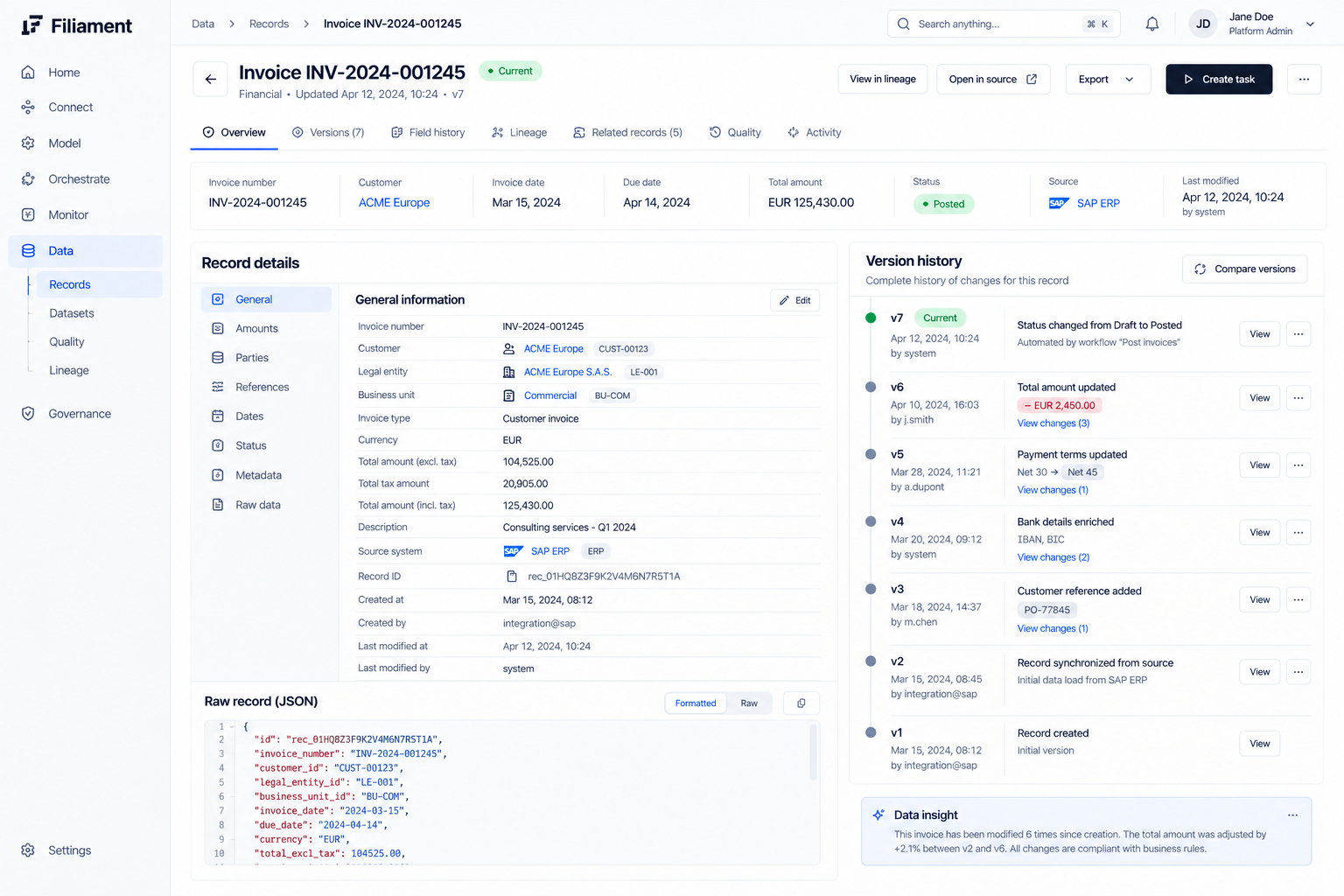
Three screens from a live workspace.
The ontology, the runs, and one record with its full history. Click any of them to open it full screen.
Filiament connects your systems, models your business in one ontology, processes and orchestrates data across the stack, and serves it to every consumer. Governance, auditability and execution controls run through all four blocks.
Each system is connected once, through its own connector: one of ours off the shelf, or a custom one when the source system needs one. Raw data lands in datasets and is prepared there. The system is then mapped onto the ontology, which gets extended only when it brings something the model does not already cover.
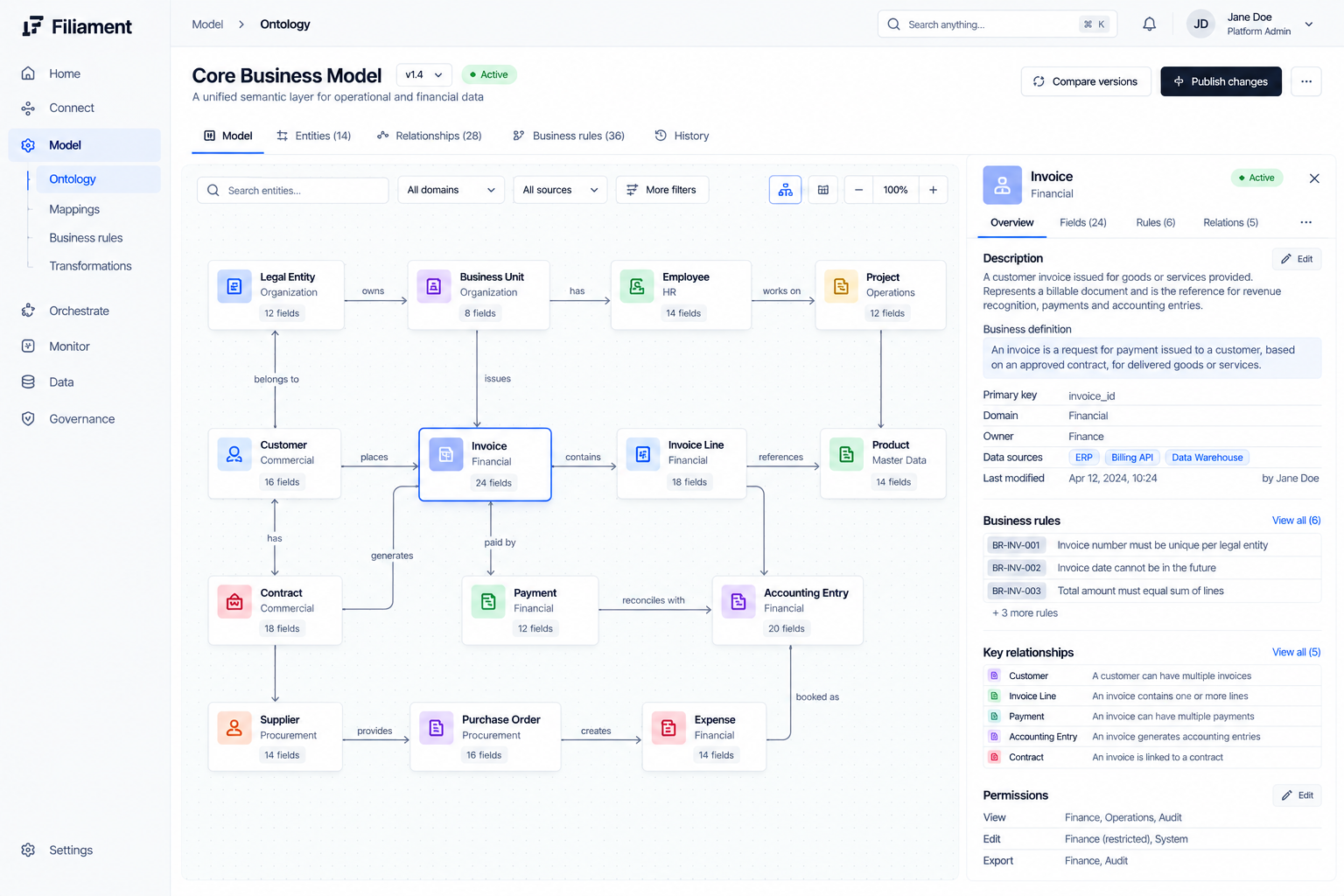
The ontology is the smallest shared model the business can operate on, so a record coming from an ERP and a record coming from an accounting instance mean the same thing.
One record, one identity. The same real-world record is recognized across every system it lives in. Filiament links a record to its replicas instantly, which is what makes reconciliation and audit possible at all.
Business rules run on the modelled data. Records are transformed and reconciled across systems by workflows that execute as ordered tasks, each with its own status, duration and logs.
Every change can be simulated as a dry run before it touches production. The layer is bidirectional: it reads from your systems and writes validated records back into them, in the same governed flow. Data lineage covers the pipelines themselves: every table can be traced back through the workflows that built it.
Each run is tracked: what executed, what succeeded, what failed. Failures trigger automatic retries; anomalies raise alerts to the right people instead of propagating silently. Teams follow it in the interface, or get only what concerns their scope: an alert in Slack or Teams the moment a flow breaks, a report by email every morning.
The layer exposes its data the way each consumer needs it: an API for applications, MCP for AI agents, a feed to the data lake for analytics, and feeds for BI and reporting. Teams can also query the modelled data directly, read-only, with the same permissions that apply everywhere else. The same model and the same permissions apply, whoever is asking.
The layer governs reads and writes alike. A classic data platform only ever sees the reads. Governance here means four concrete things: who can see and do what, what happened to each record, execution that behaves the same way every time, and a dry run before anything is written back to a source system.
One role-based access model governs the whole layer. Every consumer, a person, an application or an agent, connects with its own identity, and roles decide which data each one can see and which actions it is allowed to run. Each one can be audited, guardrailed, and disabled in one click. The rules are defined once, on the ontology, and apply from connection through to consumption rather than being re-implemented in every tool.
A full audit trail on every record. What changed, who or what changed it, when, and through which process. Any past state can be reproduced and explained.
AI helps write transformations and workflows; an expert reviews and approves them. What runs in production is deterministic, versioned and replayable code. An agent can read what it is allowed to read and trigger what it is allowed to trigger; it never improvises a change to your systems.
Any change can be replayed against production data without writing to it. Not a staging trick: a native operation of the platform, available on any change. Teams see exactly which records would move, and how many, before a single one does. Nothing reaches a source system until someone has read that result and validated it, on your side or ours.
The data, the code that produced it, the audit trails, and the orchestration state, in one governed place. Whatever runs on top, an agent, a copilot, the AI writing your next workflow, sees the full picture, and only what it is allowed to see.
The ontology, the runs, and one record with its full history. Click any of them to open it full screen.
Bring your systems map and one operational problem. We will show you what the four blocks do with it.
Request a demo